
Luxury of the Past

— illustrated catalogue

Gnezdovo:
Thirteen Finds
from a Dnieper Trading Settlement

On the upper Dnieper, a few kilometres west of Smolensk, lie the remains of one of the largest settlements of tenth-century Eastern Europe: a hillfort, an open settlement, and thousands of burial mounds. No written source certainly names it. What survives are things — silver from Central Asia, swords, Scandinavian ornaments, Byzantine amphorae, silk and seals. These thirteen finds show how the place was connected to the world around it.

c. 30 hectares of settlement
4,500–5,000 burial mounds at the cemetery's greatest extent
1,400+ Islamic silver coins, whole and fragmentary, in hoards
9th–11th c. at its height in the 10th century
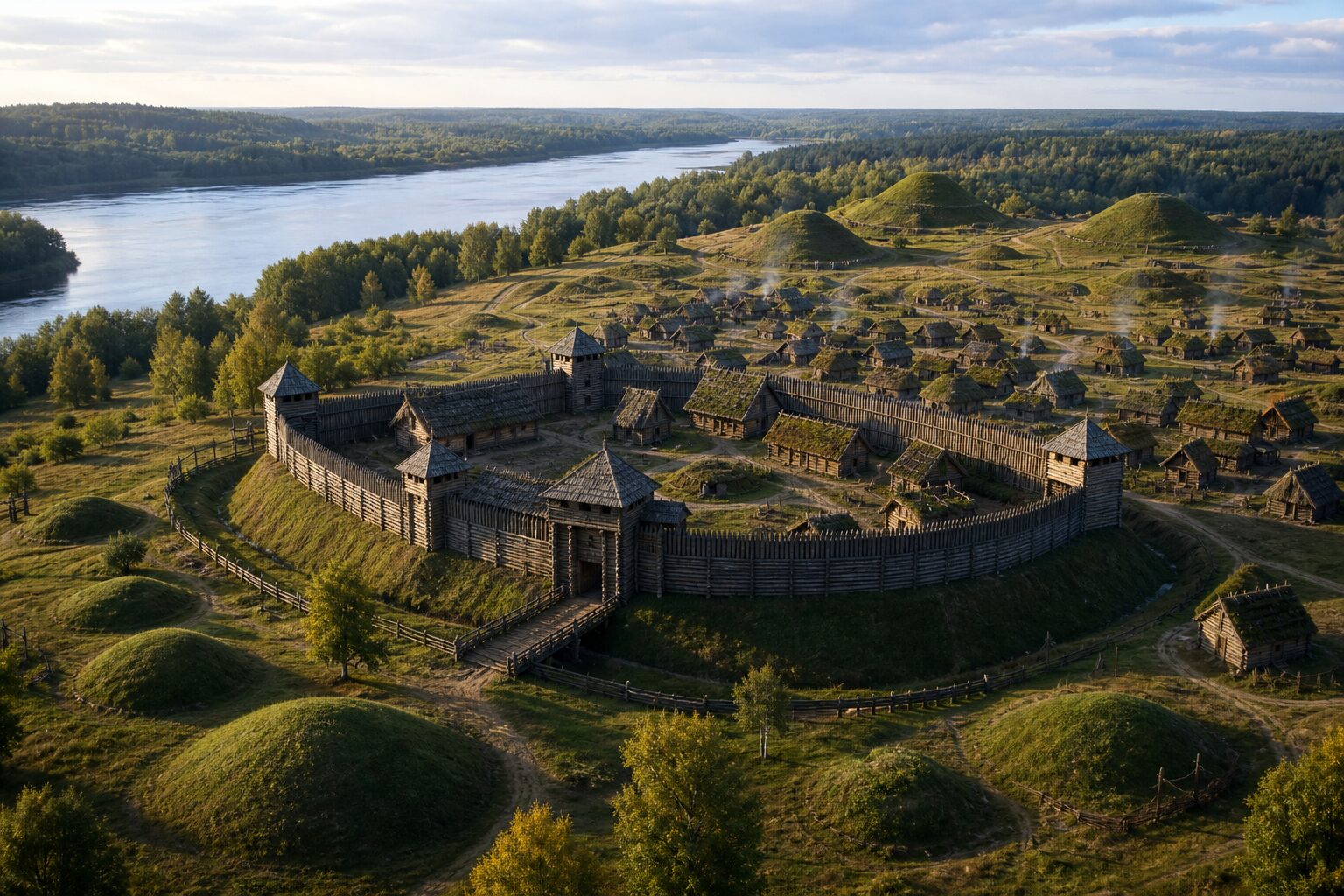
Illustration of a fortified settlement and burial mounds beside a river
Illustration. An imaginative view of a settlement and burial mounds on the Dnieper — not an archaeological reconstruction.

Gnezdovo lies on the Dnieper close to the portages that linked it with the Western Dvina, the Lovat and the route north to Lake Ilmen and the Baltic. Archaeologists of the State Historical Museum in Moscow describe it as an early urban centre: a fortified hillfort, an open settlement of about thirty hectares, harbour areas and, by the end of its life, some 4,500–5,000 barrows in at least eight groups. The Gnezdovo museum-reserve describes the cemetery as the largest surviving pagan barrow cemetery of the ninth to early eleventh centuries in Europe.

Excavation began in 1874 and has continued, with Moscow State University and the State Historical Museum leading work for decades. Some scholars connect Gnezdovo with Miliniska, a town named by the Byzantine emperor Constantine VII in the mid-tenth century and usually identified with Smolensk; the identification is debated. What is not in doubt is that Gnezdovo stood on the river route between the Baltic and the Black Sea, and that people there handled goods from all along it.

— catalogue

Thirteen finds

Filter by type of object, or by where it came from. Each card opens to give details, context and sources.

What
From

Showing 13 of 13 finds

Full text of the catalogue

Every entry with its description and sources, for continuous reading and for readers without JavaScript.

Swords

Swords are rare finds anywhere in early medieval Eastern Europe, and Gnezdovo has produced more than most sites. In their survey of the site, Eniosova and Pushkina counted 16. Excavations in 2017–18 raised the total of swords and sword parts to 31, according to a report in the journal Voennaya arkheologiya.

Most blades of this period were made in Frankish workshops and travelled east through trade, gift and plunder; hilts were often fitted or replaced closer to the place of use. A sword in a burial is evidence of wealth and status as much as of fighting.

Numbers change with each excavation season, so any count should be read with its date.

A helmet of disputed origin

The helmet comes from barrow Dn-86, excavated by S. I. Sergeev in 1901, and is now in the State Historical Museum in Moscow. The museum dates it to the third quarter of the tenth century.

Its origin is debated. A. N. Kirpichnikov argued for an eastern source; others, including M. V. Gorelik, have pointed to Western European parallels; S. Yu. Kainov has proposed a Central European, Great Moravian connection. The disagreement is itself informative: Gnezdovo sat where several traditions of arms and armour met.

Dirham hoards

Eniosova and Pushkina list thirteen tenth-century hoards from Gnezdovo, containing more than 1,400 Islamic silver coins, whole and fragmentary. Eleven of them, coin and coin-and-object hoards, fall into five chronological groups: the late 920s; the late 930s; the late 940s to late 950s; the first half of the 960s; and the last third of the tenth century.

Samanid dirhams of the first third of the tenth century make up about 53 per cent of the dirhams from Gnezdovo — the Central Asian silver described in our feature The Dirham Road.

A hoard found in 2013 consisted of trade equipment; another, with a latest coin of 952, combined coins with scales and weights.

Byzantine coins, and gold worn as pendants

Outside the hoards, more than 500 coins have been found in burials and on the settlement. About 90 per cent are dirhams and their Volga Bulghar imitations. Byzantine coins make up just over 9 per cent — about fifty, mostly copper folles struck between the sixth and the early eleventh centuries. Two Western European deniers have also been found.

Two Byzantine gold coins (nomismata) had been turned into pendants: here coins were worn as jewellery and as signs of status, not spent.

Scandinavian ornaments and amulets

Eniosova and Pushkina count more than 350 brooches, pendants, amulets, bracelets and belt fittings of Scandinavian types, and more than 500 Scandinavian finds in all. On this basis they estimate that at least a quarter of the burials can be associated with Scandinavians.

Linking objects to the identity of the people buried with them is never straightforward: ornaments were traded, given and copied. The figures describe a strong Scandinavian presence in a mixed community, not a Scandinavian town.

Excavations by Moscow State University in 2026 found neck-rings with Thor's-hammer pendants, a type well known in Scandinavia and along the eastern routes.

Folding scales and weights

More than 170 weights have been found on the settlement and about 250 in all, together with parts of more than thirty folding scales. Scales or weights were placed in 52 barrows.

Coins and fragments of silver were weighed, not counted, and a merchant's scales could follow him into the grave. For the coins themselves, see Dirham hoards.

Byzantine amphorae

Excavations in 2008–2013 on a trench of only 72 square metres produced more than seventy amphora fragments, dated to the second half of the tenth and the first half of the eleventh century.

Amphorae travelled for what they contained. Their presence this far up the Dnieper shows that goods from the Black Sea reached the settlement in quantity.

The inscribed jar

The vessel was found in 1949 by D. A. Avdusin in barrow L-13. Scratched on it is a short Cyrillic word that has been read in several ways: as "mustard" (first proposed by M. N. Tikhomirov and D. A. Avdusin), as "combustible" (G. F. Korzukhina, A. S. Lvov), and as a personal name in the possessive, "Goruna's" (R. Jakobson, V. Kiparsky, O. N. Trubachev).

The date is also discussed. The latest coin in the burial was struck in 907/908, but A. A. Fetisov has argued that the inscription was made no earlier than the 930s, and probably outside Rus'. What is agreed is that it is among the oldest surviving examples of Cyrillic writing from the lands of Rus'.

Glazed tableware and the senmurv dish

Gnezdovo has produced three dishes, four mugs and three miniature jugs of Byzantine glazed ware. The most remarkable is a polychrome dish decorated with a senmurv, found by V. I. Sizov in 1885 in the so-called Large Barrow.

Close parallels come from Preslav in Bulgaria. Eniosova and Pushkina suggest that such vessels were distributed as diplomatic gifts rather than sold as ordinary goods.

Byzantine lead seals

Four lead seals of high-ranking Byzantine officials are known from Gnezdovo. Seals were attached to letters and documents to authenticate them.

They show that written communication from the Byzantine administration reached the settlement, although what the documents said, and who received them, is unknown.

Crosses and reliquary crosses

Crosses and encolpia (reliquary crosses) have been found at Gnezdovo, including three reliquary crosses of Byzantine and Balkan–Danubian types.

They show contact with Christian practice in a community whose burial rites were largely pagan. A cross on its own does not tell us what its wearer believed.

The encolpion of 1970

Found in 1970, this encolpion shows a figure in the orant posture — standing with raised hands in prayer. The Orthodox Encyclopedia attributes it to a Syrian provincial workshop.

An object made at the eastern edge of the Byzantine world and buried on the upper Dnieper is a small illustration of how far portable things could travel.

— connections

Where it all came from

Several directions meet at one point on the Dnieper. From the north came Scandinavian ornaments and people; from the south, Byzantine amphorae, glazed ware, silk, seals and crosses; from the east, Samanid silver by way of the Volga; from the west, sword blades of Frankish types. Some objects, like the helmet, resist easy attribution. And much of what was found was used, repaired and buried by the people of Gnezdovo themselves.

    — how to read this page

    Sources and caveats

    This selection is based mainly on publications of the State Historical Museum in Moscow, above all N. V. Eniosova and T. A. Pushkina's survey of Gnezdovo as an early urban centre, together with museum records and excavation reports cited on each card. Most of this literature is in Russian.

    Counts change as excavation continues, so figures are given with their source and, where it matters, their date. The selection is not complete: a century and a half of excavation has produced tens of thousands of objects.

    Debated questions are left open — among them the origin of the helmet, the reading of the inscribed jar, the share of Scandinavians among the population, and the identification of Gnezdovo with towns named in written sources.

    Corrections, 7 October 2026: the number of barrow groups ("at least eight"), the chronology of the hoards and the description of the 2013 hoard have been corrected against Eniosova and Pushkina; the dating of the inscribed jar is now attributed accurately to Fetisov.